“August” a Concept for a Piece for Baritone Voice and Pre-Recorded Playback

While I grew up in Wisconsin, my father’s parents retired to Florida. Accordingly, nearly every year of my childhood, my family would drive in August from Wisconsin to Florida in order to spend a week with my grandparents. This annual trip was something I looked forward to all year long, and these trips were a formative experience for me.

My parents argued and fought verbally frequently.  However, during our annual trips we were all the best versions of ourselves, and generally speaking they were the most harmonious experiences we had as a family. My family loved to travel. Ironically, when I arrived at the airport to fly home when my father was dying, I instinctually got excited as I usually do, anytime I set foot in an airport. Given my father’s love of traveling, I think he would have understood.

These annual car trips were formative in other ways as well. I grew up in an era before the ubiquity of screens.  A one, two, or three-day car trip from Wisconsin to Florida requires somewhat of an internal game. It requires a person to be able to occupy themselves: to converse, read, listen to music, observe, or think. Learning this practice from a young age has served me well. I find that I rarely feel bored. 

Another way in which these trips were formative relates to how I began to think of the nature of time. Our perception of time is fluid.  There are times when time seems to move quickly, and other times it seems to move slowly. There is also the seemly contradictory experience in which hours may seem to fly by while the days into weeks seem to drag (or vice versa). 

Driving through the flat landscapes such as Indiana presents a situation, in which the horizon seems still and unchanging. Meanwhile, the middle ground changes, but at a snail’s pace.  However, telephone poles whip by a a good clip, and if you look directly down at the pavement outside the car, the motion is dizzying. That is the nature of time.  At any given moment time can change to any of these perspectives, based upon our emotions and environment, potentially creating an illusion of time being both rapid and slow.

During my teen years, my relationship to drives to Florida strengthened.  When I was fifteen years old, my Grandmother had a stroke, and was moved to a nursing home, dying a year later.  As a result, my Grandfather was living alone.  At this time, if my father had a few days off from his job as a high school teacher, he and I would drive straight down to Florida without a break, stay with Grandpa as long as we could, and drive straight back. It was often just the two of us in the car, and we bonded very closely on these trips. Once I had my driver’s license, he and I would alternate driving, switching ever three to four hours. To this day, I feel closest to my Dad when I am driving long distances.
“Pantone” for Theremin and Video

I have been playing theremin for a little less than a year.  The instrument has quickly become a passion for me.  As a composer, it is desirable for me to be able to publicly perform some of my own works.  Thus, the challenge is to write a piece for an entry level performer that is still going to engage an audience sufficiently.

Setting the piece at a slow tempo allows the theremin to focus on slow lyrical lines that are within my grasp as a performer. The fixed audio part, created using Apple’s Logic Pro, serves as a compliment to the slow, lyrical nature of the theremin.  The fixed audio uses faster, often syncopated rhythms that add a surface level energy to the piece.

Another way to add energy and excitement to the piece is to add a visually engaging video to accompany the work.  The concept behind the work attempts to bridge the visual and audio worlds.  In the visual realm, pantone refers to a color classification system. In sound, I offer pantone as a description of an instrument, like the theremin, that can create any frequency that exists between its highest and lowest possible notes.

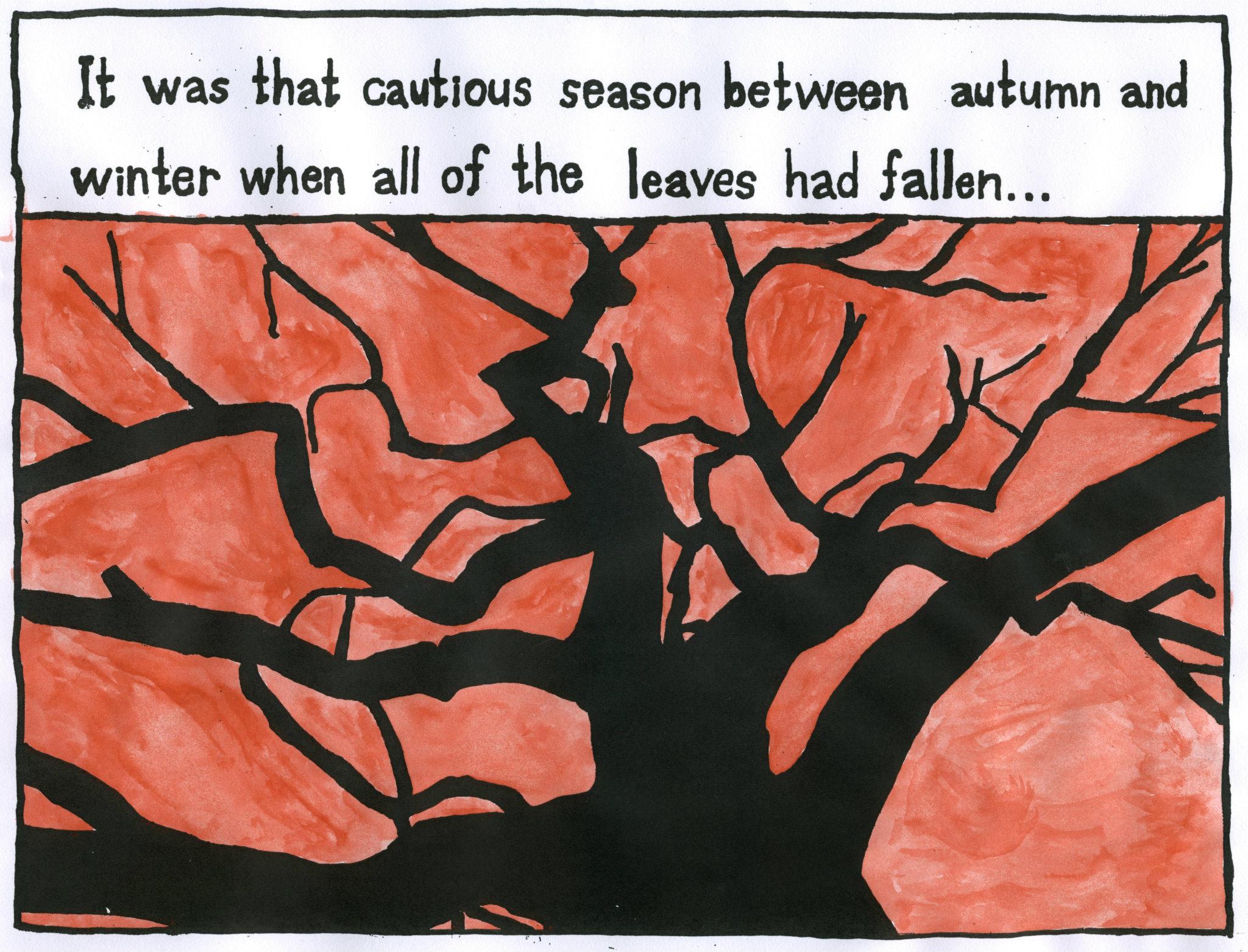
Creating a video for Pantone creates another set of problems, related to my relative inexperience as a visual artist.  Years ago I wrote a chamber opera, Into the Cautious Season, that used projected images that were similar in nature to a graphic novel representation of the plot and libretto to both set the scene, as well as to display the libretto.  I created the graphic novel version in black and white as well as a version using some color.  Inspired by the water color skies used in It’s the Great Pumpkin Charlie Brown, I used watercolor paints on the black and white images to create a limited color version.

cautious

Due to my lack of skill as a visual artist, I cannot say that the graphic novel version of Into the Cautious Season was successful.  However, I can say that it was good enough to be a proof of concept, and that I believe a version done by someone with decent illustration skills could work well. Moreover, I began to think that simple scans of single color fields of watercolor paint could make an interesting basis for a video.

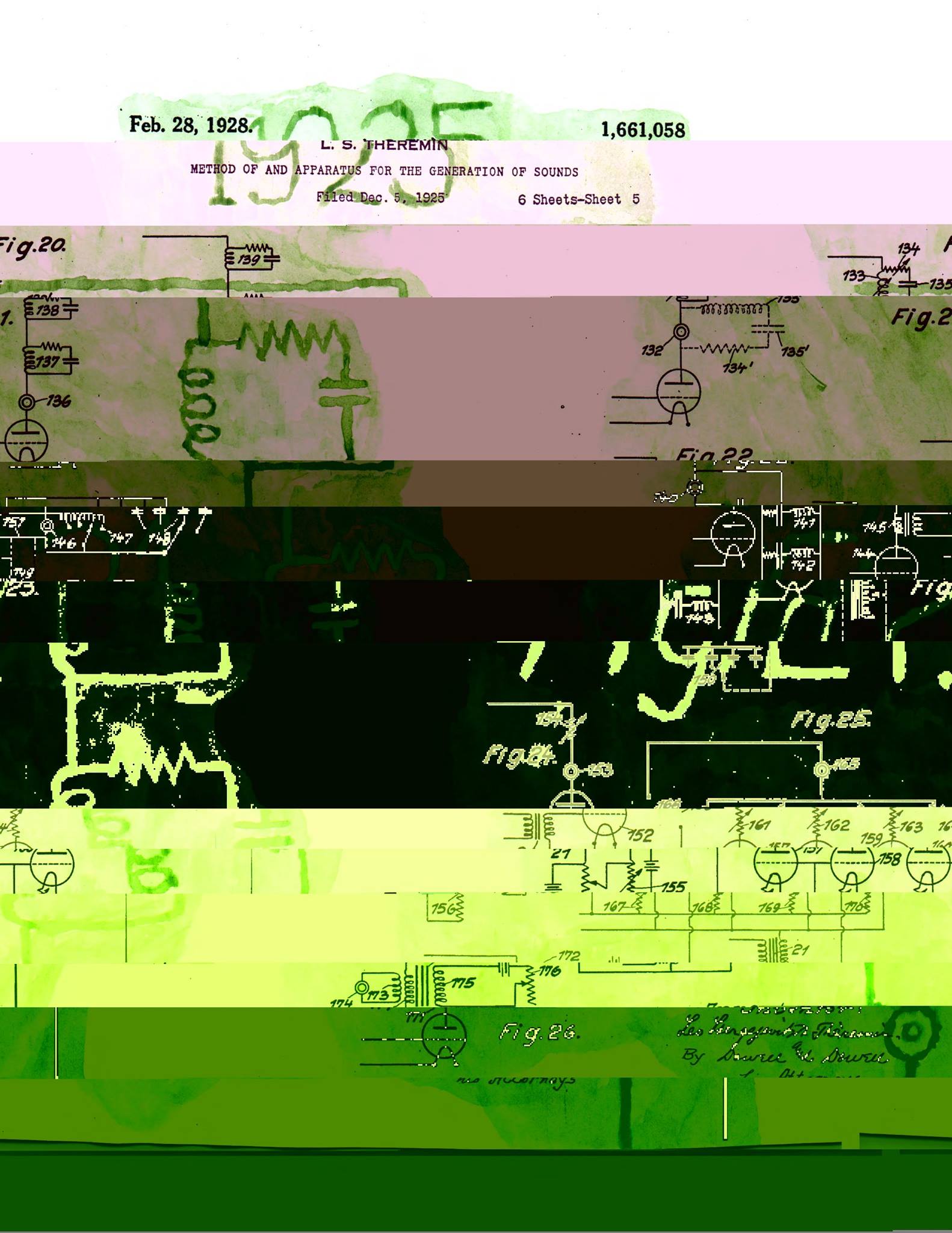
For Pantone I started with nine black and white images from the patent drawings for the theremin.  Then, I used watercolors to paint single color designs that mimic the designs on top of the drawings.  After scanning the images into a computer, I then made nine glitched versions of each, by changing each image file to a text file, copying, pasting, and deleting material before changing the file back into image files.

glitch

For each musical phrase of Pantone I superimposed nine of these glitched images on top of each other in Apple’s Final Cut Pro.  I set each layer to zoom in and out and to move about independently of the other images. Furthermore, each layer was set to only let a percentage of colors through. This approach resulted in a detailed, yet slow moving texture of colors. One final detail added to the video involved adding an increasing number of visual accents that coincide with musical accents.  These were achieved by exporting specific frames as images, glitching those image files, and superimposing them for about four frames over the video.

glitchaccent

Sonically speaking Pantone is an homage to the future of my youth.  When I was a child, commercially available analog synthesizers were relatively new.  Artists like Wendy Carlos, Don Dorsey, Jean-Jacques Perry, and Isao Tomita created sonic palettes that will always sound like the future to me. In creating the fixed audio accompaniment for the piece, I emphasized timbres that emulated these analog synthesizers.

Ultimately I believe that Pantone offers several features that can engage listeners:  lyrical melodic material performed on a novel instrument, a fixed audio part that is rhythmically energetic, a sonic palette that invokes a nostalgic science-fictionesque world, and a colorfully meditative visual component filled with detail.

(in performance in Pawtucket, RI on December 4th, 2016)

(in performance in Bridgewater, MA on March 1st, 2017)